Solar panels on a tile roof: why tiles break, and why an older roof should be redone before the panels go on
Most tile-roof homeowners we talk to in Orlando don’t find out the solar crew cracked anything until the first hard rain, months after the panels went live. By then the installer has been paid, the crew is three neighborhoods away, and the water stain on the ceiling is the only evidence.
If you’re about to put solar on a tile roof, or you already have and something isn’t right, the two things worth knowing are how tiles actually break during an install and why the age of the roof underneath matters more than the tiles you can see from the street.
Have questions?
Why solar installs break roof tiles
Concrete and clay tile shrugs off wind and sun for decades. What it can’t take is a point load. A person standing on the wrong part of a tile, or setting a 40-pound panel down on it, is a point load.
A solar install puts a lot of feet on a roof. The crew walks it to lay out the array, walks it again to set the mounts, again to run rails and wiring, and again carrying the panels themselves. That last trip is where most of the breakage happens. Tiles that survived three passes crack when a person crosses them with an extra 40 pounds in their arms.
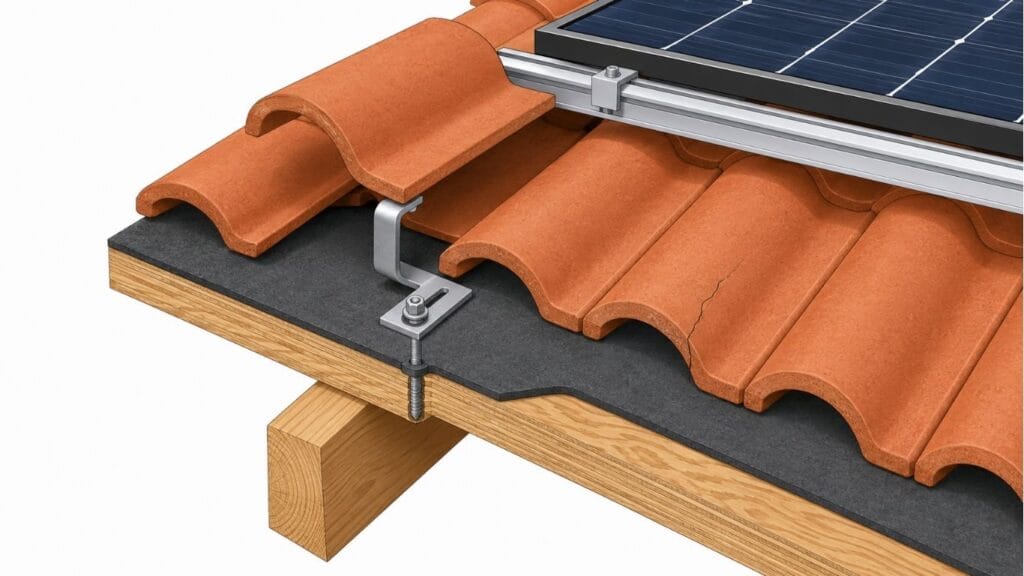
The mounts are the second cause. On a barrel or S-tile roof, the standard method is a hook that slides under a tile and bolts to the deck. On flat concrete tile, the mount usually replaces a tile with a metal flashing plate. Both methods mean lifting tiles, drilling through the underlayment into the rafters, and setting tiles back down over hardware. Every one of those steps is a chance to crack the tile being moved or the one next to it.
The third cause shows up years later. Any time someone comes back to service the array, clean the panels, or swap an inverter, they walk the same paths. Roofs that were fine after the install pick up new breaks on the second and third visits.
How many tiles break on a typical job? A careful crew on standard S-tile or flat concrete tile breaks somewhere between two and eight tiles. Measured another way, expect two to five percent of the tiles in the work area. Homeowners in solar forums report losing 20, 30, even 40 on bad days, and a Facebook thread that ranks for this exact question asks whether six or seven broken tiles is normal. It is. The question is whether anyone told you.
A cracked tile is not the problem. What’s under it is
The tiles on a Florida roof are not what keeps water out of the house. They’re the shade and the armor. The waterproofing is the underlayment underneath them, a layer of felt or synthetic membrane sealed to the deck.
A cracked tile lets water reach the underlayment. Good underlayment sheds it. Worn-out underlayment doesn’t. So the same crack on two houses produces two very different outcomes: on a roof with fresh underlayment, nothing happens for years; on a roof with 20-year-old felt, the leak starts with the next storm.
The timeline is what matters. Concrete tile in Central Florida lasts 40 to 50 years, clay longer. Solar panels are built for 25 to 30. But felt underlayment in our heat lasts 15 to 25 years, and on the shorter end of that if the attic runs hot or the roof has seen a lot of foot traffic. The layer with the shortest life is the one buried under both the tiles and the panels.

How old is too old for solar on a tile roof
Nobody can give you a perfect number without getting on the roof, but the ranges below hold up across the tile homes we see in Dr. Phillips, Windermere, and Winter Park.
Under 10 years old with the original underlayment: put the panels on. Have the installer replace every tile they break, in writing, before the crew arrives.
Ten to fifteen years: get the underlayment checked first. If it was standard felt, it’s in the second half of its life. If it’s a synthetic or peel-and-stick product, you probably have runway.
Fifteen years or older with original felt: this is the roof the article is about. The tiles look fine. The underlayment is at or near the end. Putting a 25-year array on top of it means the roof will need work while the panels are still producing, and every one of those panels has to come off and go back on for that work to happen.
Which roofs can’t take panels at all? A roof with active leaks or a sagging deck, and any tile roof where tiles are already slipping and cracking on their own. A solar company that is willing to mount on that roof is not doing you a favor.
The math on doing the roof first
Here’s what it costs to get the order wrong.
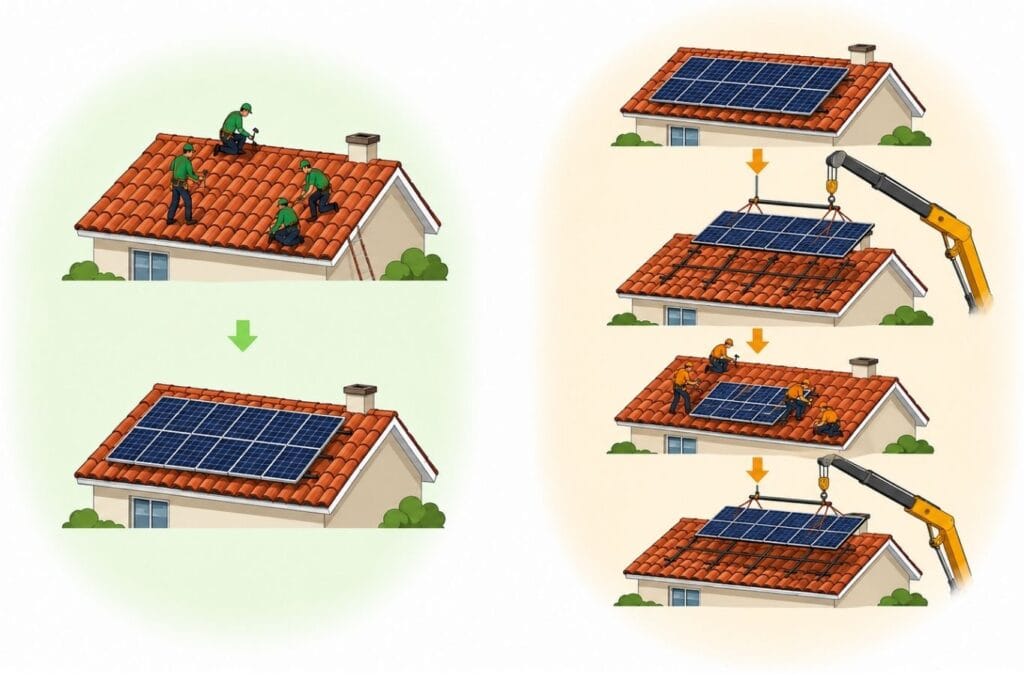
Solar panel removal and reinstallation, which the industry calls a detach and reset, runs about $250 to $400 per panel this year. On a typical 20-panel Orlando system that’s $5,000 to $8,000, paid to the solar company, before the roofer touches anything. You also lose the array’s production for however long the roof work takes, and you’re depending on the original installer still being in business and still answering the phone.
Now compare the roof work itself. Full tile roof replacement on a 2,000-square-foot Central Florida home runs $22,000 to $45,000. Underlayment replacement on the same home, where we lift the existing tiles, replace the underlayment, and set the same tiles back down, typically runs $8,000 to $15,000. That second option is the one most 15-to-25-year-old tile roofs actually need, and it’s the one that gets skipped because nobody mentioned it before the panels went up.
So the sequence is: roof work, then solar. Do it the other way and you’ve added a $5,000 to $8,000 line item to a job that was going to happen anyway, plus the breakage risk of a full second install on your tiles.
If timing is the problem rather than the decision, ask about financing. The point is to do the layers in the right order, not to do them all at once.
Already have solar and a leak?
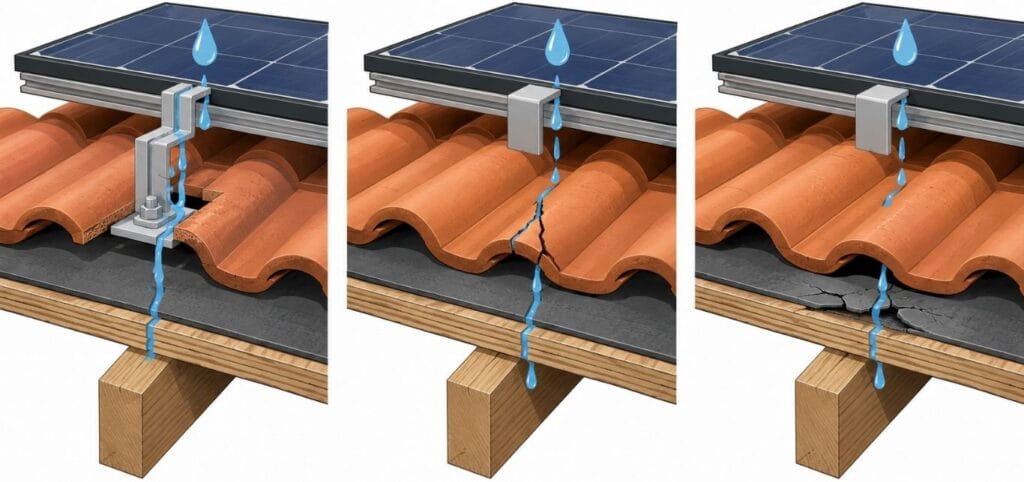
If the ceiling stain showed up after the panels did, there are three likely causes, and they get fixed differently.
The first is a mount penetration that wasn’t sealed properly. This shows up early, usually in the first rainy season after the install, and it’s the solar installer’s workmanship. Your contract with them should cover it. Get them back out before you call anyone else.
The second is a cracked tile the crew didn’t catch or didn’t replace. Water reaches the underlayment through the crack, finds a seam or a nail hole, and comes through. This is a tile repair, and on a healthy roof it’s a small one.
The third is underlayment that was already at the end of its life. The install didn’t cause the leak, it just added foot traffic and penetrations to a roof that was about to fail anyway. This is the expensive one, because now the array is in the way of the repair.
How do you repair a tile roof with solar panels on it? It depends on where the leak is. If the damaged tiles are outside the array’s footprint, we work around the panels. Fire code caps most residential arrays at roughly a third of the roof’s footprint before setback rules tighten, so there’s usually more open roof than people expect. If the leak is under the array, the panels in that section have to come off. We coordinate that with your solar company so the electrical disconnect and reset are handled by the people licensed to do it, and the roof work in between is handled by us.
Will homeowners insurance cover it? Sometimes, if the damage traces to a storm. Age-related underlayment failure and installer error usually fall outside the policy. Our insurance claims page walks through how we document damage either way.
How this works with Orlando Roof Tech
We don’t install solar, and we don’t pretend to. We’re a licensed Florida roofing contractor (CCC1332678) with 15-plus years on Central Florida tile, and we do the roof side of solar jobs in whichever order you’re in.
If you haven’t gone solar yet, the first step is a free roof inspection. We check the underlayment, not just the tiles, and tell you plainly whether the roof will outlast the array. If it will, we’ll say so and you can move ahead with your installer. If it won’t, you get a written scope for either a full tile roof replacement or an underlayment replacement that reuses your tiles, and we’ll coordinate the timing so the solar crew lands on a finished roof.
If you already have solar and a problem, same first step. We inspect, identify which of the three causes you’re dealing with, and if the panels need to move we work directly with your solar company on the detach and reset so you’re not stuck refereeing between two contractors.
Eighty-three Google reviews at 5.0 stars. Fair estimates, and a crew that will tell you when the answer is “your roof is fine.”

Questions people ask
Should I replace my roof before installing solar? If the tile roof is 15 or more years old with original felt underlayment, yes, or at least replace the underlayment. Under 10 years, usually no. In between, get the underlayment inspected before you sign a solar contract.
What happens to my solar panels if I need to replace my roof? They come off and go back on. The solar company disconnects, removes, and stores them, the roofer does the roof, and the solar company reinstalls and reconnects. Budget $250 to $400 per panel for that step.
Can a roof be replaced without removing solar panels? No. Tile can’t be lifted and underlayment can’t be replaced under a mounted array. Repairs outside the array’s footprint can be done around it.
Is it difficult to replace a roof with solar panels? It’s two jobs instead of one, with two contractors and a schedule to coordinate. The roof work itself is standard. The difficulty is the sequencing and the extra cost.
Why is my roof leaking after installing solar panels? One of three things: an unsealed mount penetration, a tile the crew cracked, or underlayment that was already worn out and gave up under the extra traffic. The first is the installer’s responsibility. The second and third are roof repairs.
Is a solar company responsible for roof leaks? For leaks caused by their penetrations or their breakage, yes, under the workmanship terms of your install contract. For underlayment that was already aging, generally no.
How common are roof leaks with solar panels? Uncommon on a roof with sound underlayment and a careful crew. Common enough on older tile roofs that entire Reddit threads exist about it.
Does homeowners insurance cover solar panel damage to a roof? Damage from a covered storm usually qualifies. Installer error and normal aging usually don’t. Document everything either way.
What roofs can you not put solar panels on? Roofs with active leaks, deck damage, or tiles already slipping and cracking on their own. Fix the roof first.
Does a tile roof need underlayment? Yes. The underlayment is the waterproofing. The tiles protect it from sun and impact and shed most of the water, but the membrane underneath is what keeps the house dry.
What is the best underlayment for a tile roof in Florida? A synthetic or self-adhering membrane rated for high heat. It costs more than felt and lasts noticeably longer under a Central Florida attic.
What are the common problems with tile underlayment? Drying out and cracking from heat, nail holes opening up as the felt shrinks, and tears from foot traffic. All three get worse with age and all three are invisible from the ground.
How do you repair a roof if you have solar panels? Outside the array, normal tile repair. Under the array, the affected panels are removed by the solar company, the roofer repairs, the panels go back. We coordinate both halves.
What is the 33% rule for solar panels? A fire-code threshold. Once an array covers more than about a third of a roof’s footprint, wider setbacks from the ridge and edges apply so firefighters can move. The practical upshot for roof repairs is that most residential arrays leave the majority of the roof open.
Why is it harder to sell a house with solar panels? Usually it isn’t the panels, it’s the paperwork: a lease or financing agreement the buyer has to assume, or a roof that’s due for replacement under an array the buyer now has to pay to move. A new roof under a paid-off array is a selling point.